We hear you! We hear you! You liked our brief intro to Advanced Subscription Agreements or ASA, and now you want more.
Yes, raising capital is one of the most crucial and challenging steps for startups and early-stage businesses. At times, it can feel like riding a theme park roller coaster ride: exciting, fast-paced, thrilling, full of twists and turns, a little nerve-wracking and sometimes you don’t know where you will land.
Founders must find ways to secure funding (and often quickly) while maintaining control of their company and navigating complex valuation processes. One investment tool that has gained traction among startups (especially in the UK) is the ASA. This funding mechanism offers an alternative to traditional equity financing and convertible loan notes, providing investors with a somewhat easier path to equity ownership while deferring valuation complexities.
What are Advanced Subscription Agreements?
An ASA is a legally binding contract between a company and an investor, where the investor pre-pays for shares that will be issued at a future funding round. Unlike a convertible loan note, an ASA does not function as debt; there is no repayment obligation and no interest accrual.
ASAs are commonly used by startups and early-stage businesses, particularly in the UK, where they often qualify for the Seed Enterprise Investment Scheme (SEIS) or Enterprise Investment Scheme (EIS) tax relief. This makes them attractive to investors seeking tax benefits on their early investments.
This structure allows startups to raise funds quickly without determining an exact company valuation upfront, which can be difficult for early-stage businesses with limited financial data or limited revenues.
ASAs offer several advantages for both startups and investors:
For Startups
- Startups can delay valuation until a later funding round, avoiding premature pricing
- Companies receive funds immediately, improving cash flow
- Unlike loans, ASAs do not create debt or interest payments
- Many ASAs qualify for tax relief in the UK (SEIS/ EIS tax benefits) making them attractive to investors
For Investors
- Investors typically receive shares at a discount, increasing potential returns
- ASAs may qualify for SEIS/ EIS relief, reducing investment risks
- Investors get an opportunity to fund high-potential businesses at an early stage
- For startups seeking flexible fundraising, ASAs can be a strategic option, but careful consideration of investor expectations and future financing rounds is essential. Investors, on the other hand, must weigh the advantages of discounted shares and tax benefits against the risks of uncertainty in valuation and delayed equity issuance.
Risks & challenges of ASAs
Despite their benefits and attractiveness, ASAs are indeed “advanced” and come with risks that both founders and investors should consider:
For Startups
- Issuing discounted shares can dilute existing shareholders
- Investors expect the startup to secure a future funding round to complete the share issuance
- Share price depends on the next round’s valuation, which may be lower than expected.
For Investors
- If the company fails to raise capital, investors may not receive shares
- Investors do not receive immediate equity, unlike direct share purchases
- The final share price depends on future valuation, which could be lower than anticipated
Comparing ASAs to other investment arrangements
ASAs differ from other funding arrangements such as convertible loan notes, SAFE Agreements, and direct equity investments.

Comparing ASAs to SAFEs
In September 2024, we wrote an article on SAFEs, and whether we would consider them to be “safe”. An ASA is similar to a SAFE, instead of cashing in on front row seats, investors get a future slice of the company through agreements like the ASA or the SAFE. These structures let startups secure funding now while promising investors shares later, but which is one is the better VIP pass?
Similarities
- Both ASAs and SAFEs allow investors to provide funding before shares are issued (ie money now, get shares later)
- Neither agreement requires an immediate valuation, making them attractive for early-stage startups
- Investors typically receive shares at a discount when the next funding round occurs
- Both are equity-based, meaning they do not function as loans and do not accrue interest
However, there are some key differences:
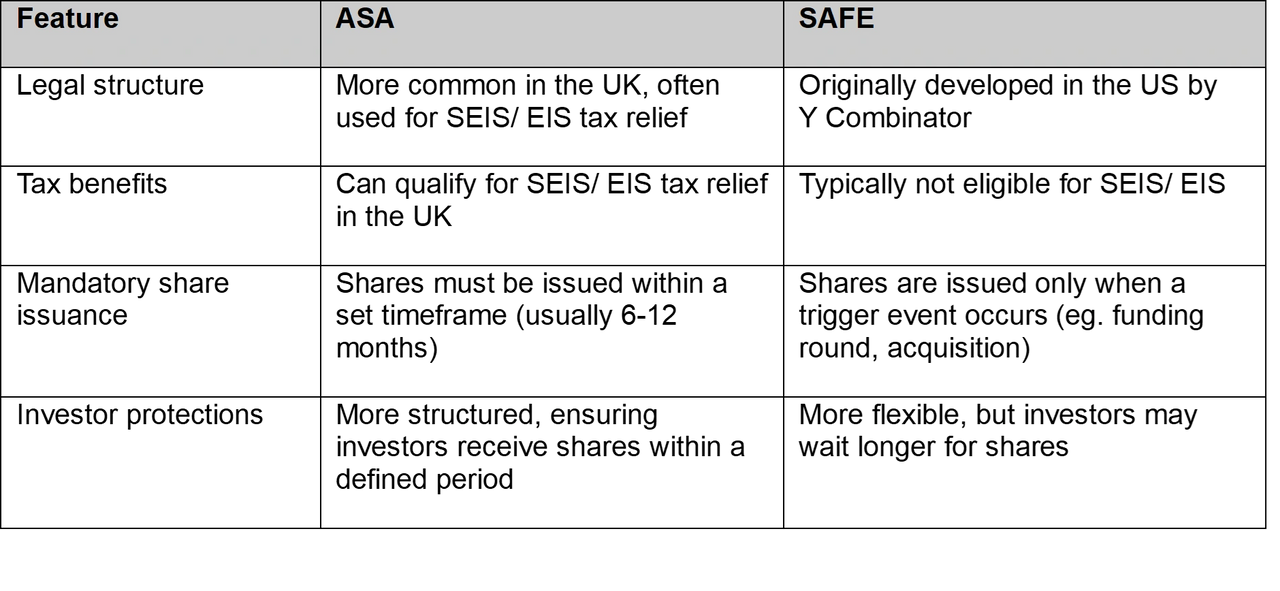
Think of ASAs and SAFEs like booking a flight, both get investors to their destination (equity), but with different terms and different timelines. The ASA is like a direct flight, investors know when they will land (conversion deadline), and it is more structured and predictable. The SAFE is more like an open-ended travel voucher, great flexibility, but no fixed arrival time.
So, which is better, ASA or SAFE note?
If you prefer more flexibility and you are operating in the US, a SAFE might be more suitable.
If you (like us at Farringford Legal) are based in the UK and you want SEIS/ EIS tax benefits, an ASA is likely the better choice.
Talk to us, we can help guide you on this exciting journey.

Farringford Legal is your growth partner, providing affordable, expert legal services across England & Wales with a client-centric, entrepreneurial approach. We are not just lawyers; we are allies in your business journey, adapting as your business evolves, deeply trustworthy, always responsive.
www.farringfordlegal.co.uk | info@farringfordlegal.co.uk